

When you're eating less, every bite has to work harder. Here's how to make it count.
GLP-1 medications have transformed how millions of people think about appetite and weight. And while the progress is real, there's a nutritional conversation that isn't keeping pace. When you're eating significantly less, the quality of every bite becomes everything. Protein, fiber, healthy fats - the building blocks of Mediterranean-style eating - aren't just nice to have, they're essential.
If your appetite suddenly shrinks… your nutrition strategy needs to expand. That’s the paradox of the GLP-1 era.
The Hidden Cost of Eating Less

GLP-1 medications work by mimicking a hormone your gut naturally produces after eating. This hormone signals fullness, slows digestion, and dials down appetite. They're remarkably effective. People using GLP-1s for obesity typically reduce their caloric intake by 16 to 39%. That's a significant drop.
The problem? That large, rapid reduction can lead to insufficient intake of essential vitamins and minerals, including iron, calcium, magnesium, zinc, and vitamins A, D, E, K, B1, B12, and C. A 2025 study published in Frontiers in Nutrition found that GLP-1 users were falling short on vitamin D, potassium, choline, magnesium, and iron. These are the very nutrients that support energy, bone health, immune function, and mood. A separate retrospective study found that over 20% of patients on GLP-1 medications had a diagnosed nutritional deficiency within their first year of treatment.
This isn't a reason to avoid these medications. It's a reason to eat smarter while you're on them.
The New Math: Fewer Calories, Higher Standards
Think of it this way: if you were given 1,200 calories to spend in a day, every single one needs to pull its weight. There's simply no room for the nutritional equivalent of an empty seat.
A joint advisory from the American College of Lifestyle Medicine, the American Society for Nutrition, the Obesity Medicine Association, and The Obesity Society made it clear: GLP-1 medications are not enough on their own. Personalized, nutrient-dense, minimally processed diets are essential to help patients maximize and maintain health gains over time. Translation: the quality of what you eat has never mattered more.
And then there's the muscle question. One of the lesser-talked-about side effects of rapid weight loss, with or without medication, is muscle loss. Research published in Nutrients found that EVOO's anti-inflammatory and antioxidative properties show real promise in supporting muscle mass and slowing muscle wasting, a finding that takes on new significance in the age of GLP-1s.
Enter the Mediterranean Diet: Your Nutrient Density Blueprint

If there's one eating pattern built for exactly this moment, it's the modern Mediterranean diet. Not because it's trendy, but because it's the most extensively studied dietary pattern on the planet and it was designed around exactly what the body needs to thrive.
The Modern Mediterranean diet emphasizes vegetables, fresh fruits, nuts, legumes, and whole grains, with extra virgin olive oil as the primary source of fat, alongside moderate to high consumption of protein (fish, seafood, grass-fed meat, eggs, and dairy).
Every element of that list is nutrient-dense by design. Every meal is an opportunity to replenish what your reduced appetite might otherwise leave behind.
Here's how to build a genuinely nourishing Mediterranean plate when you're not eating much:
Lead with protein. Grilled fish, eggs, legumes, or Greek yogurt. Protein preserves muscle, sparks metabolism, keeps you fuller longer, and is the nutrient most commonly under-consumed on GLP-1s.
Add fiber and color, not just volume. Dark leafy greens, roasted vegetables, beans, berries, tomatoes, and olives pack iron, magnesium, and antioxidants into small, flavorful portions. You don't need a massive plate. You need a smart one.
Make every fat count. This is where EVOO earns its place. Compared with other dietary fats and low-fat diets, EVOO is superior in managing clinical biomarkers including blood pressure, LDL cholesterol, and protective HDL cholesterol. It also helps your body absorb the fat-soluble vitamins A, D, E, and K that GLP-1 users are most at risk of losing.
Finish with something whole. A small piece of fruit, a handful of walnuts, a few squares of dark chocolate. Satisfaction doesn't require volume when the ingredients are real.
EVOO: The Overachiever in the Pantry

We've talked about what EVOO does for blood sugar (slows the spike). We've talked about what it does for inflammation (fights it). But in the context of GLP-1s and nutrient density, EVOO plays an entirely different and equally important role.
It's a delivery system.
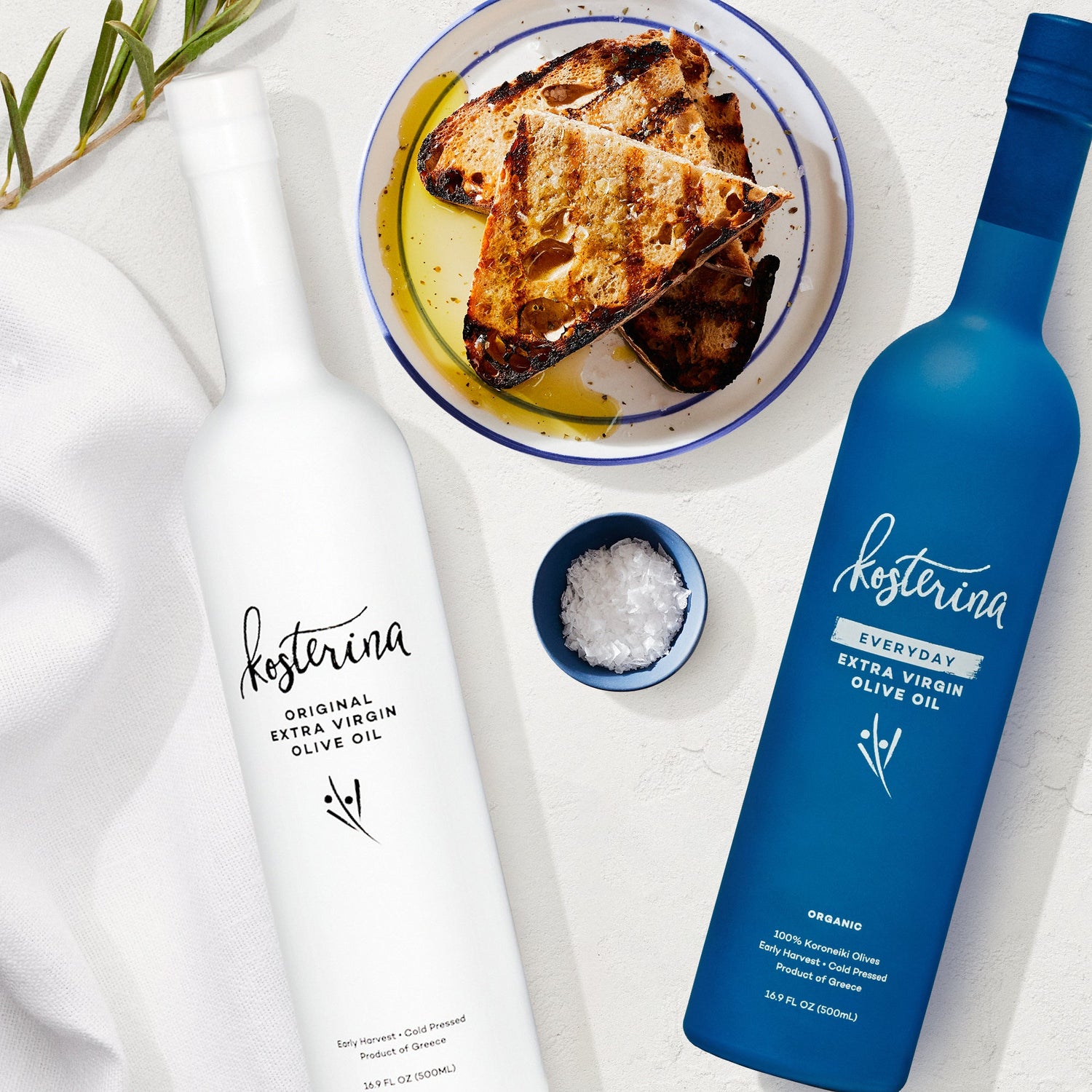
Vitamins A, D, E, and K are fat-soluble, meaning your body can only absorb them in the presence of dietary fat. Drizzle Kosterina EVOO over roasted vegetables and you're not just adding flavor. You're unlocking the nutrients already on your plate. In the landmark PREDIMED study, patients assigned to a Mediterranean diet enriched with EVOO saw reductions in body weight, waist circumference, and cardiovascular risk, outcomes that no low-fat diet has consistently matched.
A generous drizzle. That's the whole ask.
Make Every Bite Count
GLP-1 medications are a powerful tool. But a tool is only as good as the conditions around it. Eating less makes what you eat exponentially more important, and the modern Mediterranean diet anchored by high-quality EVOO is the most evidence-backed answer to that challenge.
Every meal is a chance to nourish your body with intention. Not restriction. Not deprivation. Just really, really good food chosen wisely, prepared simply, and drizzled generously.
That's the Kosterina way. And right now, it's exactly what the science is asking for.
Peace, Love & EVOO,
Katina and The Kosterina Team
Frequently Asked Questions
Do GLP-1 medications cause nutritional deficiencies? They can. Because GLP-1 medications significantly reduce appetite and calorie intake, users are at higher risk for deficiencies in key nutrients including vitamin D, iron, magnesium, potassium, and B vitamins. Focusing on nutrient-dense foods and consulting a dietitian is strongly recommended.
What should I eat while on a GLP-1? Prioritize protein, healthy fats, and colorful vegetables at every meal. The Mediterranean diet is widely recommended by nutrition experts as the ideal eating pattern to complement GLP-1 therapy. It maximizes nutrient density while supporting muscle preservation and metabolic health.
Why is the Mediterranean diet good for GLP-1 users? It's rich in the exact nutrients most depleted by reduced calorie intake including iron, magnesium, vitamin D, and antioxidants, while being naturally anti-inflammatory and satisfying even in smaller portions.
What role does olive oil play in nutrient absorption? Extra virgin olive oil is a healthy fat that enables your body to absorb fat-soluble vitamins A, D, E, and K. Drizzling EVOO over vegetables or salads doesn't just add flavor. It dramatically improves how well your body absorbs the nutrients already on your plate.
How much olive oil should I use per day? Most research points to 1 to 2 tablespoons of high-quality EVOO daily as the sweet spot for health benefits, enough to support absorption, heart health, and anti-inflammatory function without excess calories. Check out Koserina’s EVOO Shots for your daily dose of wellness!